Work Base Learning M21358
- up2185946
- May 30, 2023
- 6 min read
The Renovation of Historic Building
My Name is Ishaq Hussain and studying MA interior architecture and design in University of Portsmouth. In the Work Base Learning subject I selected Pay Office building Project for Interior Renovation.
The Title of my selected project is The Renovation Of Historic Building

Fig 1 Ankle deep web
My Research Question
How can the interior designer maximize functionality through small space utilisation while balancing the aesthetic and conservation impacts of an adaptive re-use design of a historic building?
Introduction
The outcomes of the work-based learning module will be examined and critically reflected upon in this essay. My design-based research focuses on the adaptive reuse of a historic building and the utilisation of small spaces to accommodate multiple present-day activities. It is now more difficult than ever to create an interior environment that is optimal. Our sense of architecture can be significantly impacted by the spatial organization of space. This idea is particularly crucial in the context of the Pay Office Building, where the spatial arrangement of the art works in the gallery space helps us to sharpen our attention on personal perspectives. .
Renovating a historic building is a major endeavour that demands considerable thought and preparation. In relation to the Pay Office Building, it offers the possibility of transforming the area, improving the visitor experience, and displaying artwork in a more interactive and significant manner. However, critical reflection on the remodelling process is required to ensure that it aligns with the gallery's aims and values while honouring the artists and their work.
One factor to examine is the Pay Office Building’s historical and architectural significance. Renovations should try to preserve the original structure's integrity, especially if it has cultural or historical value. As the Pay Office Building lies with Portsmouth’s Historic Dockyards, it is critical to find a balance between the modernization of the gallery and keeping the building’s particular identity, resulting in a balanced combination of old and new.
Another important reflection is the influence of the renovation on the artwork itself. The Pay Office Building art galleries provide a platform for artists to display their work, and the restoration should complement rather than overwhelm or undermine it. Lighting, display arrangements, and exhibition rooms must be carefully created to showcase the aesthetic quality of the artwork while also providing visitors with a meaningful and immersive experience

METHODOLOGY
Conversations and Interviews
The research methodology involves conducting interviews with both client and architectural scholars to gain insights into their understanding of the design challenges. This helps in identifying the key issues, requirements and constraints. Additionally, the methodology considers the physical, social, and historical circumstances surrounding the project, which helps in creating designs that are responsive to the context. The focus is on offering flexibility and accessibility in the building design, ensuring that it caters to the diverse needs of the users. Furthermore, the methodology emphasizes visualizing and photographic the aesthetic and design components, enabling visual analysis and a clear representation of the intended look and feel of the project. This comprehensive approach ensures that the design solutions are informed, contextually appropriate, and visually appealing.

CASE STUDY THE LOUVRE MUSEUM
The Louvre Museum is one of the world's most famous historic buildings and art galleries. It stands as a symbol of art, culture, and history in the centre of Paris, France. Originally built as a stronghold in the 12th century, it gradually grew into a palace before becoming a prominent museum. The Louvre Museum is not just a historic architectural spectacle , but it also holds a vast collection of art dating back thousands of years.
History and Architecture:
With a long and checkered history, the Louvre Museum's architectural style is a mix of Renaissance, Classical, and Baroque elements. The contemporary glass pyramid, designed by I.M. Pei and completed in 1989, serves as the main entrance and has become emblematic of the institution. The design emphasises the museum's grandeur without compromising its historic architectural integrity; while its function as an open, light space of welcome helps to improve the visitor experience.
Art Collection:
‘’The Louvre Museum is home to a huge and diverse collection of art from numerous ages and cultures. Over 35,000 pieces of art, including paintings, sculptures, prints, drawings, and archaeological artefacts, are housed there. Leonardo da Vinci's "Mona Lisa," the ancient Greek sculpture "Venus de Milo," and Eugène Delacroix's painting "Liberty Leading the People" are among the most iconic masterpieces on exhibit at the Louvre’’.

Key Findings
‘’In 1798, the Dockyard Pay Office was constructed under the supervision of Sir Samuel Bentham. This building was notable for being the first fire-proof structure in the Dockyard and showcased an early combination of brick and cast iron materials. Initially designed as a two-storey building, it suffered significant damage during German bombings in the Second World War, resulting in its reduction to a single storey. Notably, it was within these walls that Charles Dickens' father served as a pay clerk during the birth of his son on February 7th, 1812. The establishment of the Portsmouth Royal Dockyard Historical Society (PRDHS), primarily comprising former Dockyard employees, aimed to preserve the disappearing artefacts, skills, and trades associated with the Dockyard. Vigorous attempts were undertaken to gather exemplary specimens of machinery, tools, drawings, photographs, scientific testing apparatus, and other significant remnants that represented the material culture of the Dockyard, ensuring they were safeguarded from the passage of time’’.
Location and site

SITE VISIT

Project Assessment
•Conduct a full examination of the present interior, including spatial arrangement, circulation patterns, lighting, and overall mood.
•
•Assess the usefulness, condition, and relevance of current furniture, fixtures, and equipment to the new design idea.
•
•Consider the building's historical and architectural value to ensure that any improvements adhere to preservation rules.
Concept Development:
I created design concepts that optimized space utilization and boosted functionality based on the project goals and user needs.

I explored possibilities for creating a collaborative work atmosphere, which could also enhance privacy and individual focus where necessary, and optimised natural light and vistas.

I considered aspects of sustainable design, such as energy efficiency, and the use of environmentally friendly materials.

PROPOSED DESIGN LAYOUT
I proposed a design to implement spatial reconfigurations to optimize the layout and increase workflow efficiency. This might include the removal of moveable partitions, and the inclusion of flexible workstations and modular furniture solutions.
I improved illumination of the space and artworks by combining natural light with energy-efficient artificial lighting options. The design considers task lighting, accent lighting for focus locations, and day lighting solutions.
By enabling employees to come together in an aesthetically inspiring and comfortable environment, I aim to promote collaborative creative working, underpinning the purpose and culture of the organisation.

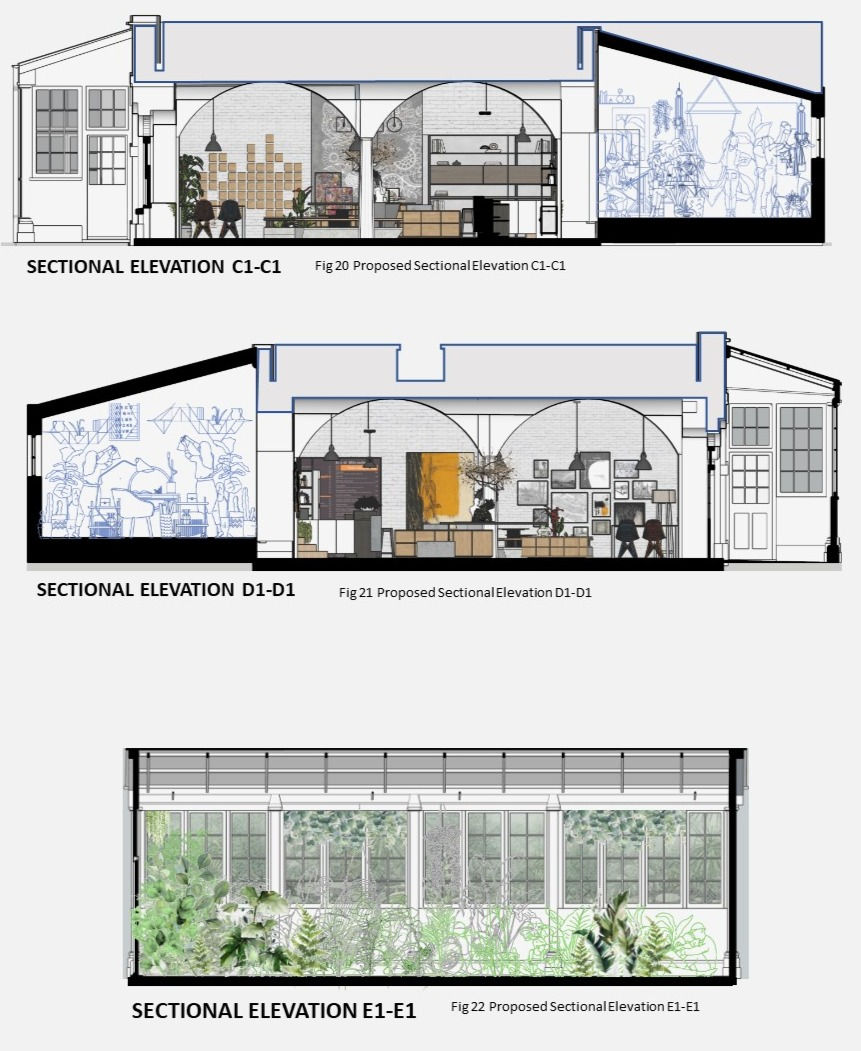
SECTIONAL ELEVATION

The building section is dedicated to displaying human activities, artwork exhibition, paintings, and handmade work, which provides visitors with a colourful and immersive experience. Visitors are delighted talent, and aesthetic expression as they enter this section.
The display of diverse artworks is one of the section's main features. The walls are adorned with paintings by renowned painters, each work expressing a distinct tale and reflecting the spirit of the artist's vision. Visitors may experience a wide range of creative genres, from classical masterpieces to cutting-edge modern works. The carefully picked collection guarantees a balanced representation of diverse times, genres, and civilizations.
Critical Reflection
Small space utilization with aesthetic considerations in a historic building presents a unique and challenging opportunity to blend functionality and beauty. Through careful planning, creativity, and respect for the building's historical significance, it is possible to maximize the use of a limited space while preserving the architectural heritage.
By adopting innovative design solutions such as multifunctional furniture, flexible layouts, and clever storage solutions, small spaces within the conservation constraints of historic buildings can be optimized to accommodate various activities and meet the needs of modern occupants. These design choices should be guided by a thorough comprehension of the building's historical context, architectural style, and original features, ensuring that any modifications seamlessly integrate with the existing structure.
Aesthetic considerations play a crucial role in small space utilization within historic buildings. The challenge lies in adjusting a balance between preserving the building's historical character and infusing modern design elements that enhance the overall visual appeal. This can be achieved by selectively incorporating modern materials, colours, and finishes that complement the existing architecture while adding a touch of modernity.
Moreover, attention to detail and a focus on creating visual harmony are essential in small spaces. Clever lighting techniques, strategic placement of mirrors, and the use of reflective surfaces can create an illusion of spaciousness and enhance the overall aesthetic appeal. Thoughtful selection and arrangement of artwork, furniture, and decorative items can further enhance the visual appeal while respecting the building's historical integrity.
In summary, small space utilization with aesthetic considerations in a historic building demands a thoughtful and sensitive approach. By integrating modern design principles with respect for the building's historical context, it is possible to create functional and visually captivating spaces that honour the past while embracing the present. The successful utilisation of small spaces in historic buildings can serve as a testament to the enduring value of architectural heritage and inspire future generations to appreciate and preserve these important structures

Conclusion
Finally, the renovation of the inside of the Pay Office Building provides a chance to create a contemporary, functional, and visually appealing office for the organisation while conserving the building's historical and architectural integrity. In the renovation process, I selected environmentally friendly products and materials to support sustainability, which equally complimented historic features, for instance, the exposed brickwork. The aim is to emphasise the relationship between contemporary sustainable practice and conservation work in the adaptive reuse of a historic building.
Through the Pay Office Building design process I adapted my understanding of small space utilisation, gained in commercial and residential contexts, into a cultural setting - both historic and arts-based, which enabled me to gain insight into the conservation and aesthetic impacts of my design choices.


Comments